An expansion on some thoughts in response to a comment by Kevin Erdman on Arnold Kling's blog.
Kevin highlight's a point about risk which is valuable, that people who buy debt (ie bonds) are generally risk averse and people who buy equity (ie stocks) are generally risk tolerant. The conclusion though is incorrect because he looks only at the buyers, and not the sellers of the assets. If buying bonds is risk aversion then selling bonds should be seen as risk tolerance, with the opposite relationship for equity, let's look at both how this is true and the implications.
First why are bonds less risky than equity? First it is because they (typically) have a claim on the underlying capital. If you buy equity in Ford and they go belly up then your equity will be wiped out. If you buy debt from ford and they go belly up your debt will be converted to equity and you are now a proud new owner of a fraction of Ford's physical capital, their manufacturing plants, their patents, and anything else worth selling or using. So you have this natural buffer where even if the overall business fails there is some value to be extracted from the ruins, which an equity holder doesn't have. Secondly it takes a much larger blow to the company to decrease the coupon payments. A decline in sales will take a whack at the equity, and the market value of bonds, but the actual income stream won't be effected until the blow is large enough to interrupt the coupon payments.
That is from the investor's perspective, now from the companies perspective this is reversed. When a company sells equity they give up a ownership stake in exchange for cash, if the stock price falls afterwards the company doesn't have to give part of that cash back. A stock issuance is low risk from the companies perspective, the total market capitalization could fall to a single penny and they don't have to repay a cent of it, the investor takes on all of that risk. Now a bond issuance, they borrow money and promise to pay it back with the company assets as collateral. If they cannot make the payments the entire company is potentially forfeit. Any risk that the investor is insulated from must be passed on to the company.
This inverse relationship is pretty straightforward. If Ford wants to build a new assembly line they can fund it through debt or equity, but funding from one or the other doesn't (shouldn't) alter the risk inherent in that capital expenditure, what funding from one or the other does is shift the risk and reward profile. If they issue through debt and it is a huge success the bondholders get their coupon payments and Ford gets all the upside of a major and profitable investment. If they fund through equity the shareholders get the upside of that profit stream. If it is a failure Ford has risked the company's assets and will have to sell them off to make their bondholders whole. If it fails and they have funded through equity the share holders take the (majority of the) loss, and the company retains all its other assets.
In a perfect world/market these things balance out perfectly every time. Total risk is constant, and distribution of risk is matched with compensation for exposure to it. Where it is a problem is when one group can offload risk onto a third party without compensation.
Friday, July 7, 2017

Wednesday, December 7, 2016
When aren't they efficient?
The approach to markets, especially betting markets, supposes that they are efficient or trending towards efficiency. There is a specific circumstance where markets no longer trend toward efficiency, that is basically never discussed.
Walk into a convince store, look at the dozen drinks on display. How many individual choices are there? Not 12, but 13. 1 for each drink, and 1 for not purchasing a drink at all. Take 130 people, each day each of the dozen drinks gets bought 10 times, and 10 times the "no purchase" is exercised.
10 people day after day are not buying drinks. If they are $1 each then after a year you have 10 people with $365 that they are willing to use on drinks if there was one they liked. This (potentially) opens up a brand new niche in the market, as the daily savings allows for a new product to enter the market. One day on the shelves a specialty drink will appear, aimed at satisfying this segment. Perhaps it will be priced at $2, perhaps $20.
Strip away the savings, instead of a dollar spent every time, give each of the 130 people a coupon for 1 drink that expires at the end of each day. Now there is no build up of savings and so no incentive to create a more expensive drink for those with particular (or peculiar) tastes.
This is the major flaw in electoral "markets", votes can't be rolled over in anticipation of a better candidate 2, 4 or 40 years down the line. Marginalized groups tend to stay marginalized and powerful groups powerful thanks to the absence of this mechanism.
Now we are potentially living in an even more dangerous time. Financial markets have become so entangled that there is no fundamental way to "save" outside of it. Sell stocks because you are worried about the economy? What are you going to do with the cash? The solvency of banks is directly tied to the solvency of the US Treasury, which is tied back to the strength of the economy.
Whenever someone makes the following mistake, "markets aren't worried about default because if they were interest rates on government debt would be higher" simply ask them this "Where should I put my money if I am afraid of a government default in my country?".
Walk into a convince store, look at the dozen drinks on display. How many individual choices are there? Not 12, but 13. 1 for each drink, and 1 for not purchasing a drink at all. Take 130 people, each day each of the dozen drinks gets bought 10 times, and 10 times the "no purchase" is exercised.
10 people day after day are not buying drinks. If they are $1 each then after a year you have 10 people with $365 that they are willing to use on drinks if there was one they liked. This (potentially) opens up a brand new niche in the market, as the daily savings allows for a new product to enter the market. One day on the shelves a specialty drink will appear, aimed at satisfying this segment. Perhaps it will be priced at $2, perhaps $20.
Strip away the savings, instead of a dollar spent every time, give each of the 130 people a coupon for 1 drink that expires at the end of each day. Now there is no build up of savings and so no incentive to create a more expensive drink for those with particular (or peculiar) tastes.
This is the major flaw in electoral "markets", votes can't be rolled over in anticipation of a better candidate 2, 4 or 40 years down the line. Marginalized groups tend to stay marginalized and powerful groups powerful thanks to the absence of this mechanism.
Now we are potentially living in an even more dangerous time. Financial markets have become so entangled that there is no fundamental way to "save" outside of it. Sell stocks because you are worried about the economy? What are you going to do with the cash? The solvency of banks is directly tied to the solvency of the US Treasury, which is tied back to the strength of the economy.
Whenever someone makes the following mistake, "markets aren't worried about default because if they were interest rates on government debt would be higher" simply ask them this "Where should I put my money if I am afraid of a government default in my country?".
Sunday, October 9, 2016
People don't appreciate scale
Marginal Revolution links to a Minimum Garaunteed job proposal, that is incredibly naive.
The US labor force is currently around 160 million people, with a 5% UE rate some 8 million people are going to be eligible for this work, assuming only 1 in 10 decides to take the government up on the offer and assuming that zero people out of the labor force get pulled back in the Federal Government will be providing jobs for 800,000 people at any one time. Of course the "safety net" is most important during times of trouble, during the last recession the UE rate peaked near 10%, to provide jobs during a period like that would result in the government running an industry of 1.6 million people. Wal-Mart is the largest employer in the US and has fewer than 1.5 million employees here.
Of course the honor system doesn't work so you need to have people oversee these activities, and managers to organize and watch the overseers (and again and again), along with payroll, legal departments (for when someone claims repetitive stress disorders from doing to prescribed activities), HR departments so people can complain that their website is down/they didn't get paid/their disabilities aren't catered to, coders on the front and back end of websites and all manner of other positions.
It is basically inevitable that this program, if it was at all successful, would become the single largest employer of people in the US, its "employees" will almost certainly agitate to form a union at some point (with some bizarre potential complications) and all of this is going to have to be designed in a way to double in size within a few months during a recession.
The most obvious blind spot in politics these days is that the sheer size of proposed solutions are generally brushed aside. I mean if Wal-Mart can build a labor force of 1.5 million over decades, then surely the government can build something even bigger with a few pen strokes, a few good intentions and a 5 page proposal outlining the finer points.
The guaranteed job will consist of a variety of mental and physical tasks that can be easily monitored either online or within existing institutions. The mental tasks might be activities such as keyboarding practice, doing arithmetic exercises on an internet training program, doing exercises in word processing, doing spread sheets, reading reports and summarizing them, or completing online courses. The physical tasks might include doing specific exercises, digging holes and filling them, moving weights, and other similar type activities. The goal of these activities is not to produce usable output for society, but to provide work activities by which people can translate their time into income. To the degree possible, these working experiences will provide training in skills and an introduction to customs and behavior useful in the real-world market jobs
The US labor force is currently around 160 million people, with a 5% UE rate some 8 million people are going to be eligible for this work, assuming only 1 in 10 decides to take the government up on the offer and assuming that zero people out of the labor force get pulled back in the Federal Government will be providing jobs for 800,000 people at any one time. Of course the "safety net" is most important during times of trouble, during the last recession the UE rate peaked near 10%, to provide jobs during a period like that would result in the government running an industry of 1.6 million people. Wal-Mart is the largest employer in the US and has fewer than 1.5 million employees here.
Of course the honor system doesn't work so you need to have people oversee these activities, and managers to organize and watch the overseers (and again and again), along with payroll, legal departments (for when someone claims repetitive stress disorders from doing to prescribed activities), HR departments so people can complain that their website is down/they didn't get paid/their disabilities aren't catered to, coders on the front and back end of websites and all manner of other positions.
It is basically inevitable that this program, if it was at all successful, would become the single largest employer of people in the US, its "employees" will almost certainly agitate to form a union at some point (with some bizarre potential complications) and all of this is going to have to be designed in a way to double in size within a few months during a recession.
The most obvious blind spot in politics these days is that the sheer size of proposed solutions are generally brushed aside. I mean if Wal-Mart can build a labor force of 1.5 million over decades, then surely the government can build something even bigger with a few pen strokes, a few good intentions and a 5 page proposal outlining the finer points.
Wednesday, September 21, 2016
Self driving cars and PSST
Arnold Kling thinks that self driving cars will push people away from car ownership almost entirely, and underesitmates the complexity of car ownership.
He does, to his credit, say "if", but the reliable and affordable are never going to be affordable enough. Kling's view of the economy is summed up by his description of Patterns of Sustainable Specialization and Trade (PSST), whereby complex relationships are constantly trying to find an equilibrium, he would be good to think of the complex relationships Americans (in particular) have with their cars, and how that could be replicated in the real world.
First off lots of people customize their cars, and I am not talking about rims and paint jobs. One of our cars has two kids seats in it, with straps adjusted to their sizes, a collapsible stroller in the trunk along with a fair amount of dirt, bits of snacks wedged into the seats, and various toys and children's books scattered about. For a ride sharing company to meet my individual demand for a car they are going to need at the ready a car with two kids seats of the right size near my house, not have a passenger shortly after me allergic to peanuts, and not care or charge for cleaning out dog hair, mulch or topsoil. I may be unusual in the specific things that I do with my car, but I am hardly unusual in that I do specific things with my car.
The second problem is one of use patterns. The issue with rentals of any kind is that there is always a peak load that needs to be filled. Hotels are expensive not because it costs $36,500 ($100 a night) a year to build, rent, maintain and profit off a single hotel room but because most nights hotel rooms sit empty, and then a handful of times a year they are packed to the brim. It is a fact of life that the times that you want to use X are usually the times lots of other people want to use X. For the majority of people to use Uber or Lyft instead of their own cars their fleets will have to be large enough to accommodate the peak load on roads, you know, rush hour. Not only will they have to be big enough to handle the average load, but they will also need to be big enough to handle the worst traffic days when an accident, breakdown or construction doubles commute times, and all the 9 am traffic who, theoretically, would be riding around in cars that the 8 am traffic used is suddenly stranded and running an hour late.
Lastly fully automated autos are going to reduce a lot of the non financial costs of driving. The boredom of sitting in traffic will be replaced by entertainment, the discomfort many feel sitting in car seats can be replaced with better designs now that the steering wheel is out of the way, and the safety risks of driving should be mitigated. An economist should expected that self driving cars will reduce the costs of driving, and so should increase the incidence of driving. This should mean people get more use and value out of owning their individual car(s), which will push back heavily against corporate ownership.
If Uber and Lyft are reliable and affordable, then you do not need to own a car.
He does, to his credit, say "if", but the reliable and affordable are never going to be affordable enough. Kling's view of the economy is summed up by his description of Patterns of Sustainable Specialization and Trade (PSST), whereby complex relationships are constantly trying to find an equilibrium, he would be good to think of the complex relationships Americans (in particular) have with their cars, and how that could be replicated in the real world.
First off lots of people customize their cars, and I am not talking about rims and paint jobs. One of our cars has two kids seats in it, with straps adjusted to their sizes, a collapsible stroller in the trunk along with a fair amount of dirt, bits of snacks wedged into the seats, and various toys and children's books scattered about. For a ride sharing company to meet my individual demand for a car they are going to need at the ready a car with two kids seats of the right size near my house, not have a passenger shortly after me allergic to peanuts, and not care or charge for cleaning out dog hair, mulch or topsoil. I may be unusual in the specific things that I do with my car, but I am hardly unusual in that I do specific things with my car.
The second problem is one of use patterns. The issue with rentals of any kind is that there is always a peak load that needs to be filled. Hotels are expensive not because it costs $36,500 ($100 a night) a year to build, rent, maintain and profit off a single hotel room but because most nights hotel rooms sit empty, and then a handful of times a year they are packed to the brim. It is a fact of life that the times that you want to use X are usually the times lots of other people want to use X. For the majority of people to use Uber or Lyft instead of their own cars their fleets will have to be large enough to accommodate the peak load on roads, you know, rush hour. Not only will they have to be big enough to handle the average load, but they will also need to be big enough to handle the worst traffic days when an accident, breakdown or construction doubles commute times, and all the 9 am traffic who, theoretically, would be riding around in cars that the 8 am traffic used is suddenly stranded and running an hour late.
Lastly fully automated autos are going to reduce a lot of the non financial costs of driving. The boredom of sitting in traffic will be replaced by entertainment, the discomfort many feel sitting in car seats can be replaced with better designs now that the steering wheel is out of the way, and the safety risks of driving should be mitigated. An economist should expected that self driving cars will reduce the costs of driving, and so should increase the incidence of driving. This should mean people get more use and value out of owning their individual car(s), which will push back heavily against corporate ownership.
Friday, August 19, 2016
It can't all be money
I'm only two years behind on this debate about fractional reserve banking. Since I am writing for no one I can summarize it very quickly. John Tamny says that the money multiplier doesn't exist and Warren Gibson says that it does. As usual the answer comes down to definitions. Warren Gibson says that credits in your checking account (or anything part of M1) is money-
I will focus on the last 3 worlds of this line, but first a silly example. Suppose the Federal reserve prints up trillions of dollars worth of crisp, clean bills. It packs them on trucks, ships them down to Cape Canarveral, loads them onto a shuttle and blasts them into space where it escapes the Earth's orbit and sails away into the cold, black emptiness of space. Is this money? It all looks, feels and matches the legal definition of money back on Earth, but how would it effect the prices of goods and services? The obvious answer is that it wouldn't, and so the economic answer is that it isn't money. What if the Fed printed that money, but then locked it in an underground vault and held it there never intending to use it? Same answer, so when we talk about money part of the definition has to be about the accessibility of that money. On to fractional reserve banking.
Adam takes $100 and deposits it in his bank, his bank says "come back anytime and get it", then lends $90 out to Bill who deposits that $90 into a different bank. This bank also says "come back anytime and get it", and then promptly loans out $81 to Charles, and so on and so on. If you take the sum total of everyone's bank account once the process has completed there would be $1,000 totaled across them. This is where Warren Gibson gets the idea that the "money supply" must be $1,000, Tammy is a finance guy though, so he looks at the broader picture. Every dollar created after the initial deposit is an asset and a liability. When Adam's bank makes the $90 loan they create a $90 asset, but the also saddle themselves with a $90 deficit that they owe to Adam. Back to accessibility.
Can $1,000 be withdrawn from the banking system and be spent? No. If Adam withdraws his $100, then his bank has to run to Bill and demand their $90 back (assuming all deposits and loans are callable at any time), Bill runs to his bank to withdraw the $90, who has to run to Charles to get the $81. No matter how you slice it only $100 can be withdrawn from the system and then spent on goods and services, and there is no way to get the effect of $1,000 on goods and services.
This is exactly the effect that full reserve Austrians cite when they state that Fractional Reserve Banking is fraudulent, there is no way for all people in the line to effectively use their individual deposits. If some guy in the middle of the chain withdraws his $50 to spend then that immediately prevents Adam from ever accessing his full $100, while also calling in every loan made beyond that $50 deposit.
As far as empirical (anecdotal!) evidence, I think it is on the side of Tamny. Japan has a massive public debt, which has been building for a few decades now, the level of reserves held by the Japanese Central bank have exploded, and yet the only inflation seen in the immediate past was a short term blip when the sales tax increase went into effect. If M1 is money, if government bonds paying near zero are also money (which flows from the same definition as Gibson tries to use) and if inflation is due to increases in the money supply, then you can't escape the prediction that Japan should be crumbling amid hyper inflation.
Most definitely, because it fits the definition perfectly: a generally accepted medium of exchange
I will focus on the last 3 worlds of this line, but first a silly example. Suppose the Federal reserve prints up trillions of dollars worth of crisp, clean bills. It packs them on trucks, ships them down to Cape Canarveral, loads them onto a shuttle and blasts them into space where it escapes the Earth's orbit and sails away into the cold, black emptiness of space. Is this money? It all looks, feels and matches the legal definition of money back on Earth, but how would it effect the prices of goods and services? The obvious answer is that it wouldn't, and so the economic answer is that it isn't money. What if the Fed printed that money, but then locked it in an underground vault and held it there never intending to use it? Same answer, so when we talk about money part of the definition has to be about the accessibility of that money. On to fractional reserve banking.
Adam takes $100 and deposits it in his bank, his bank says "come back anytime and get it", then lends $90 out to Bill who deposits that $90 into a different bank. This bank also says "come back anytime and get it", and then promptly loans out $81 to Charles, and so on and so on. If you take the sum total of everyone's bank account once the process has completed there would be $1,000 totaled across them. This is where Warren Gibson gets the idea that the "money supply" must be $1,000, Tammy is a finance guy though, so he looks at the broader picture. Every dollar created after the initial deposit is an asset and a liability. When Adam's bank makes the $90 loan they create a $90 asset, but the also saddle themselves with a $90 deficit that they owe to Adam. Back to accessibility.
Can $1,000 be withdrawn from the banking system and be spent? No. If Adam withdraws his $100, then his bank has to run to Bill and demand their $90 back (assuming all deposits and loans are callable at any time), Bill runs to his bank to withdraw the $90, who has to run to Charles to get the $81. No matter how you slice it only $100 can be withdrawn from the system and then spent on goods and services, and there is no way to get the effect of $1,000 on goods and services.
This is exactly the effect that full reserve Austrians cite when they state that Fractional Reserve Banking is fraudulent, there is no way for all people in the line to effectively use their individual deposits. If some guy in the middle of the chain withdraws his $50 to spend then that immediately prevents Adam from ever accessing his full $100, while also calling in every loan made beyond that $50 deposit.
As far as empirical (anecdotal!) evidence, I think it is on the side of Tamny. Japan has a massive public debt, which has been building for a few decades now, the level of reserves held by the Japanese Central bank have exploded, and yet the only inflation seen in the immediate past was a short term blip when the sales tax increase went into effect. If M1 is money, if government bonds paying near zero are also money (which flows from the same definition as Gibson tries to use) and if inflation is due to increases in the money supply, then you can't escape the prediction that Japan should be crumbling amid hyper inflation.
Thursday, December 10, 2015
Inflation and UE in Japan
Two graphs presented by Scott Sumner
First Japanese GDP deflator

Quick eyeball description. Inflation from 1981-1993, no inflation from 1994-1998, deflation from 1999-2013 and inflation from 2014-2015.
Japanese UE rate
 Quick eyeball description. Declining UE from 2005-2007, flat UE from 2007-2008, rising UE in 2009, declining UE from 2010-2015.
What is the correlation between inflation and the UE rate with the information given? We have two periods of declining UE rates, both of which occur mostly under deflation, one period of rising UE, under deflation, and one period of inflation with declining UE (eyeballing looks like the same trend in decline that it had under the previous deflationary regime).
What happens if we take UE under the full range given to us by the GDP deflator graph?
 Now we also have rising UE from 1981-1988 alongside inflation. In a matrix of inflation, deflation, rising UE and falling UE there are 4 combinations (ignoring flat for both). We see all 4 combinations over a 35 year period in these graphs.
Correlation between inflation and UE in Japan = none.
What is Sumner's conclusion about Abenomics?
First Japanese GDP deflator
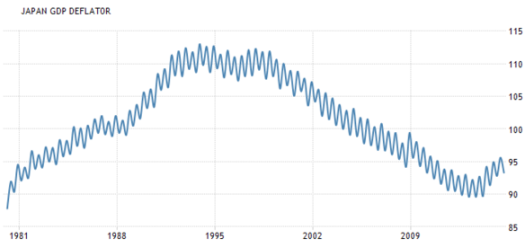
Quick eyeball description. Inflation from 1981-1993, no inflation from 1994-1998, deflation from 1999-2013 and inflation from 2014-2015.
Japanese UE rate
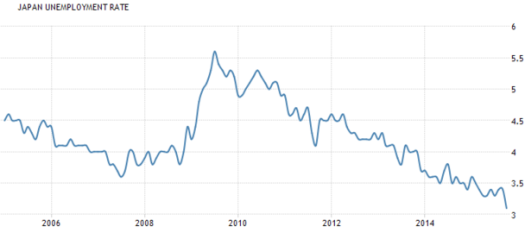
What is the correlation between inflation and the UE rate with the information given? We have two periods of declining UE rates, both of which occur mostly under deflation, one period of rising UE, under deflation, and one period of inflation with declining UE (eyeballing looks like the same trend in decline that it had under the previous deflationary regime).
What happens if we take UE under the full range given to us by the GDP deflator graph?

Correlation between inflation and UE in Japan = none.
What is Sumner's conclusion about Abenomics?
Which leads to obvious questions: who gets credit for the drop in the UE rate from 2010-2012 (Abe's party wins an election in late 2012) under deflationary pressures? Why is there no apparent change in the decline in UE rate after Abe is elected? Or again after the CB started targeting 2% inflation?I thought the monetary “arrow” would be a modest success, as they were on the right track but not doing enough. In fact, so far the monetary arrow has been an overwhelming success, beyond almost anyone’s wildest dreams.
Wednesday, May 6, 2015
Low Interest Treasuries
Here is a typical description of a liquidity trap from an economist
I doubt that anyone would defend the position that bonds are 0% like money at 0.001% and an almost perfect money substitute at 0.000%. Nor do I think that anyone would defend the position that bonds with a 20% yield are good money substitutes (though under some conditions they might be, but for now I am talking about the US from 2000-present).
So my first assumption is that the moneyness of bonds starts to become significant around a 2.5% yield. This is somewhat arbitrary, but a defensible starting position. The Fed has an inflation target around 2%, which makes bonds paying that rate or less (expected) losers in real terms. If there is an inflection point where bonds start to become more like money the expected inflation rate is a reasonable guess as to that point. I use 2.5% because inflation had typically been above 2%, and because it makes it nice and easy with the fed dropping rates by a quarter point at a time along with assumption #2.
Second assumption, debt is distributed pretty evenly by duration. Short term bonds should cover 8-10% of all debt in the US, and only publicly held debt matters for this exercise. I am going to use 10%, and the US had a publicly held debt of between 3.5 and 4.0 Trillion dollars from 2000-2003. So 3.75 trillion for an average.
So starting with bonds being 0% money at 2.5%+ and becoming 100% money at 0%, each drop of 0.25% represents 10% more "moneyness" (yes, laziness and linearness, they go arm in arm)- which effects 10% of the total debt. So a 0.25% drop below 2.5% means 1% of total publicly held debt becomes money. 1% is 35-40 billion dollars.
Using the Federal funds rate (monthly data)- October 2001 was the first breach of the 2.5% fake barrier since 1962. The rate fell to 1%, so the BotE calculation implies a 210-240 billion dollar increase in the money supply over that time period. To put that in perspective the adjusted monetary base went up by less than 200 billion dollars during that time period. This effect, if real and within half an order of magnitude of this calculation would mean the Fed loosened during this period 2 to 4 times as much as conventional estimates.
What else does it imply though? Well when the Fed started raising rates in Mid 2004 they were tightening twice as much as conventional estimates (until the rate broke 2.5%, then it magically stopped).
The real kicker though comes in 2008 when the Fed again drops below 2.5%, because total government debt was 50% higher in 2008 than in 2003 the effect would be ~50% higher. So a 50-60 billion dollar increase per 0.25% rate drop. By the time the Funds rate was bouncing around below 0.25% in December 2008 this effect would have added $600 billion dollars or so in "money" in addition to the $800 billion or so the monetary base increased.
The final implication is even more dramatic as federal debt held by the public has shot up to almost $13 trillion in 2014. That would be another $700 trillion in money "created" on top of the $1.6 trillion added to the monetary base.
This seems to me to be a very straight forward consequence of the idea that bonds and money are excellent substitutes near the zero bound. You can argue against some of the methods I used, for instance you could disagree with using the federal funds rate instead of actual US Treasury rates, or disagree with the %s used. Those disagreements would only effect the timing and magnitude of the loosening/tightening, and not the core concept.
This is just one of many examples out there discussing the implication of very low interest rates on bonds. What I have never seen from these same people is a discussion on when exactly, or even generally bonds become money-like, and the implications on evaluating monetary policy prior to 2008. I am going to run through this pretty sloppily, the assumptions and numbers here are to get a feel for the scale, and not to put a final number or even range on it.Think of a liquidity trap as a situation where investors view central bank money and treasury debt as perfect substitutes. Such a condition likely never holds exactly in reality, but that's neither here nor there. Empirical relevance is possible even if liquidity trap conditions hold approximately. In any case, if money and bonds are close to perfect substitutes, then the composition of total government debt (between money and bonds) has little economic significance (in the same way that the composition of the money supply between $5 and $10 bills does not matter).
I doubt that anyone would defend the position that bonds are 0% like money at 0.001% and an almost perfect money substitute at 0.000%. Nor do I think that anyone would defend the position that bonds with a 20% yield are good money substitutes (though under some conditions they might be, but for now I am talking about the US from 2000-present).
So my first assumption is that the moneyness of bonds starts to become significant around a 2.5% yield. This is somewhat arbitrary, but a defensible starting position. The Fed has an inflation target around 2%, which makes bonds paying that rate or less (expected) losers in real terms. If there is an inflection point where bonds start to become more like money the expected inflation rate is a reasonable guess as to that point. I use 2.5% because inflation had typically been above 2%, and because it makes it nice and easy with the fed dropping rates by a quarter point at a time along with assumption #2.
Second assumption, debt is distributed pretty evenly by duration. Short term bonds should cover 8-10% of all debt in the US, and only publicly held debt matters for this exercise. I am going to use 10%, and the US had a publicly held debt of between 3.5 and 4.0 Trillion dollars from 2000-2003. So 3.75 trillion for an average.
So starting with bonds being 0% money at 2.5%+ and becoming 100% money at 0%, each drop of 0.25% represents 10% more "moneyness" (yes, laziness and linearness, they go arm in arm)- which effects 10% of the total debt. So a 0.25% drop below 2.5% means 1% of total publicly held debt becomes money. 1% is 35-40 billion dollars.
Using the Federal funds rate (monthly data)- October 2001 was the first breach of the 2.5% fake barrier since 1962. The rate fell to 1%, so the BotE calculation implies a 210-240 billion dollar increase in the money supply over that time period. To put that in perspective the adjusted monetary base went up by less than 200 billion dollars during that time period. This effect, if real and within half an order of magnitude of this calculation would mean the Fed loosened during this period 2 to 4 times as much as conventional estimates.
What else does it imply though? Well when the Fed started raising rates in Mid 2004 they were tightening twice as much as conventional estimates (until the rate broke 2.5%, then it magically stopped).
The real kicker though comes in 2008 when the Fed again drops below 2.5%, because total government debt was 50% higher in 2008 than in 2003 the effect would be ~50% higher. So a 50-60 billion dollar increase per 0.25% rate drop. By the time the Funds rate was bouncing around below 0.25% in December 2008 this effect would have added $600 billion dollars or so in "money" in addition to the $800 billion or so the monetary base increased.
The final implication is even more dramatic as federal debt held by the public has shot up to almost $13 trillion in 2014. That would be another $700 trillion in money "created" on top of the $1.6 trillion added to the monetary base.
This seems to me to be a very straight forward consequence of the idea that bonds and money are excellent substitutes near the zero bound. You can argue against some of the methods I used, for instance you could disagree with using the federal funds rate instead of actual US Treasury rates, or disagree with the %s used. Those disagreements would only effect the timing and magnitude of the loosening/tightening, and not the core concept.
Subscribe to:
Posts (Atom)